RE-CONNECTING
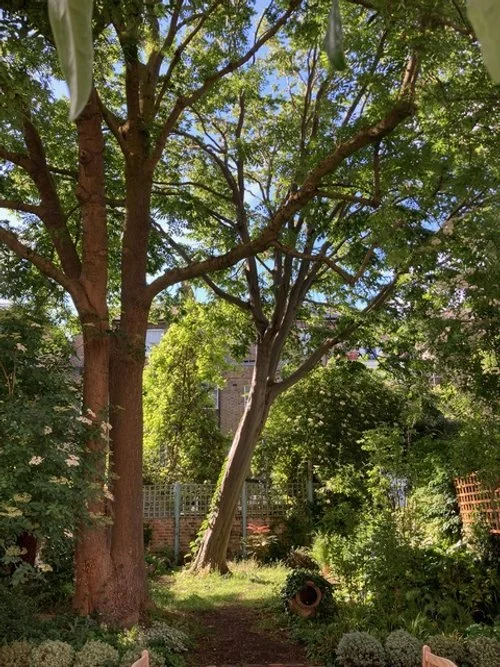
I’m sitting in the garden of our new studio, downstairs from where we live. What a privilege it is to have a garden in the middle of London; to plant and weed, water and deadhead. As always, this intimate connection with the planet gives me serenity and a sense of belonging, not to mention patience – a virtue I possess nowhere else in my life.
What a long time it has been since I wrote to you all. A very busy time, so please forgive me if this is more of a missive than an essay.
Some of you will now that Joel and I are the subjects of an award-winning documentary by Jacob Perlmutter and Manon Ouimet, entitled:
Two Strangers Trying Not To Kill Each Other. (Now available in the UK on Amazon.co.uk and Apple) During the last year we attended many of the Festival screenings and Q&A’s and then in March it was widely released in cinemas in the UK and N.Ireland… more screenings and Q&A’s. All of which was one of the most rewarding experiences we’ve ever had. Connecting with audiences in several countries, we were overwhelmed by the response and deeply touched by the open-hearted sharing from people of all ages and backgrounds.
Then in October, Jacob, (one of the filmmakers) and I began writing a play based on an idea I had many years ago. We worked 5 days a week for 6 months and held 2 successful table-readings which resulted in an acclaimed actor we’d always envisioned in one of the roles, coming on board. The script and pitch-deck are now in submission to theatres and directors, so wish us luck.
I thought some of you might be interest to know a bit about the play, so I am attaching my Artists Statement below. In order to protect the material I am not revealing the play’s title at this point.
As if all of this wasn’t enough, I had a successful exhibit of some of my art in a London Gallery and in February we moved our studio from a commercial space to the downstairs garden flat. The only downside to all of this is my backside which, after sitting on it for 6 months, disappeared along with the quads of my injured leg. So I am now working out with a trainer who basically kills me three times a week.
A strong breeze just shivered the leaves of the ash tree under which I sit, while a blackbird serenades me. Joel and I like to sit here in the evenings and listen to birdsong, some 7 species according to our bird app. We live in a peaceful neighbourhood lush with gardens rich with bees and butterflies.
Something deep shifted in me these last few months. Maybe it’s the way in which I now feel seen as a result of the documentary. I no longer have the ambition to achieve, “success.” In one of the Q&A’s someone asked me what effect the film had had on my art. I heard myself say, that I felt myself to be a successful artist who no longer needs outside acclaim, and I knew as I heard those words, that I had crossed an important line. Maybe that’s why, for the first time in my life, I am no longer in a hurry. Amazing how more there is to see and feel when you slow down.
There is much more to write about; the state of the world, ageing, working on a collection of essays, the ongoing balancing between fear and acceptance, but the garden needs watering and then I must type this up.
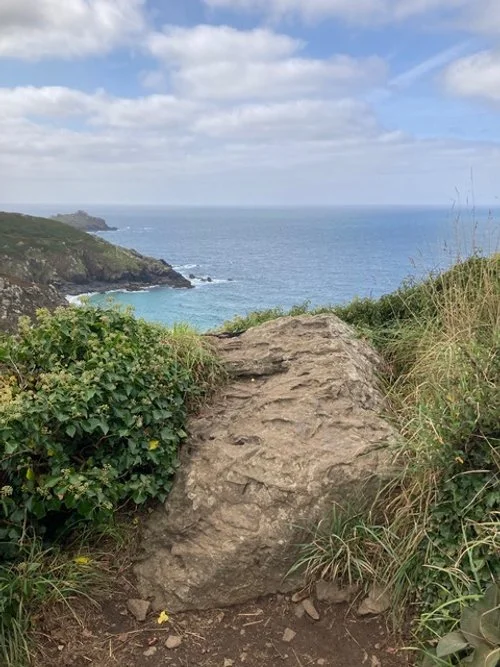
By the time you read this I will be in Cornwall with my dear Joel. I will no longer be on Instagram, preferring to spend my time in the real world, connecting on a deeper level with loved ones, art, nature, and all of you, my dear readers.
ARTIST’S STATEMENT
I first had the idea for this play in 2010 and like many creative ideas it seemed to arrive unsolicited and in a very visual form. I saw a character ensconced in a halo-vest riding a child’s tricycle and as the character rode on stage I suddenly saw the absurdity of my own history.
Most of my writing – novels, short stories, essays and poetry – deals with themes of loss and belonging, experiences which we are all familiar with to some degree, but as an adoptee it is more than an experience;
It feels cellular. The tricycle comes from a memory of my 3 year-old self riding such a vehicle up and down the hallway of my childhood home. Back and forth between the kitchen, where my parents were sitting, to the closed front door, I chanted over and over, “I don’t belong here, I don’t belong here.” Twenty-two years later, at the age of 25, having just lost my father who, it turned out, wasn’t my father, and having lost my firstborn daughter, I returned home to England and found out that I was adopted.
The halo-vest was something I wore in my early 40’s for two months as a result of breaking my neck in a car accident and undergoing a massive surgery during which ribs from a bone bank were used to hold my neck together.
That image, of a character riding a tricycle while wearing a halo-vest struck me as hilarious and I began writing a play in which incidents in my life would unfold in comedic fashion while a digital screen at the back of the stage would be used to create alternate stories and different outcomes, if different choices had been made. However, within perhaps 10 pages, I felt I didn’t require the skill for writing absurdist comedy and so I put the idea in a drawer and went on to write two novels and more than three hundred essays.
Fast forward nearly 15 years and enter Jacob Perlmutter who, with his wife, Manon Ouimet, made the award-winning documentary: Two Strangers Trying Not to Kill Each Other, a film made over the course of a year about my husband, Joel Meyerowitz, and me. Among Jacob’s many talents is his quirky, quick wit and I knew, immediately, that he would be the perfect collaborator.
Although, like all truly creative works, the play has morphed, in this case into a mother/daughter story it nonetheless has kept the elements most important to me i.e., life’s absurdity and the ways in which the past influences our lives. The role of Then appeared to us at the beginning of our collaboration as a shape-shifting, androgenous, character who is literally Rita’s, the protagonist, past. Throughout the play Then not only fills us in on the important historic facts of Rita’s life, but also verbalises her thoughts which are often contradictory to what she’s actually saying.
During the course of the play, we not only learn that Rita was adopted, and that she lost her firstborn, we also discover she was an alcoholic and druggie, was twice-married, recently widowed, and most importantly has a fraught relationship with her forty-one year-old daughter who she lost custody of when the child was four.
As someone who has experienced all of the above, I find it interesting to explore the ways in which we all use the past to inform our choices, sometimes making good choices by learning from the past, but more often making choices based on the fear that history will always repeat itself. The play explores the ways in which Rita, and her daughter, Andy, both unconsciously believe they cannot have the loving relationship they so want because of it having been denied them as a result of the loss of custody. We see the ongoing tug-of-war they’re unconsciously engaged in, behaviours that, because of the past, ensure that they won’t get what they want.
Rita’s lifelong grief as a result of being given up at birth and never knowing her mother, coupled with the loss of her first child, have convinced her that a) she’ll never be a good mother and b) her child will always reject her. Surviving rejection is a huge part of Rita’s identity. And therefore she must keep it alive. Andy, having been taken from her mother as a result of a custody battle, a wound so deep that she believes she can never have the mother she wants, causes her to act in ways that make it easy for her to come in close and then immediately leave on bad terms.
It is my hope that by having the past constantly present, in the form of Then, the audience will question the ways in which they use their own past as proof that they can’t have what they want and subconsciously make decisions that erroneously prove them right.